
What is the difference between oriented silicon steel and non oriented silicon steel brought to you by
Source:Shanghai Luanry Steel Industrial co., Ltd Date:2025-03-07 Visits:218
Silicon steel sheet, also known as silicon steel sheet, is an indispensable metal material in the power, electronics, and military industries. It belongs to the silicon iron soft magnetic alloy with extremely low carbon content, and is the most widely produced metal functional material, accounting for about 1% of global steel production. This material contains 0.8% -4.8% silicon and can be made into silicon steel sheets with a thickness of less than 1mm through hot and cold rolling processes. The addition of silicon element increases the electrical resistivity and maximum magnetic permeability of iron, while reducing coercivity, core loss, and magnetic aging. Therefore, silicon steel sheets are widely used in the manufacturing of iron cores for various motors, generators, and transformers. According to the difference in silicon content, silicon steel sheets can be divided into two categories: low silicon and high silicon.
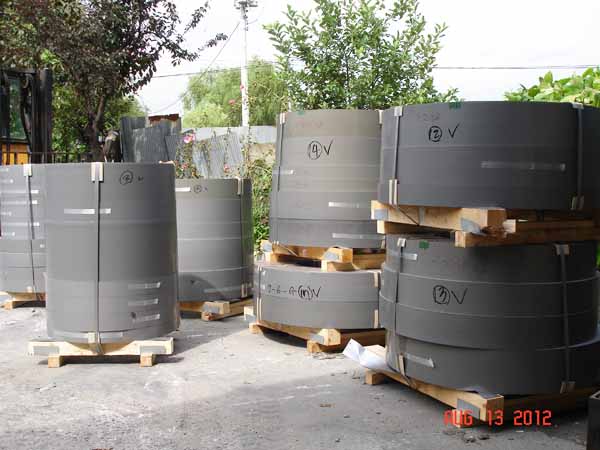
1. Low silicon wafer
Low silicon wafer, with a silicon content of less than 2.8%, has a certain mechanical strength. This type of silicon steel sheet is mainly used for manufacturing motors, and is therefore also known as motor silicon steel sheet.
2. High silicon wafer
High silicon wafers have a silicon content ranging from 2.8% to 4.8%, and although they have excellent magnetic properties, their texture is relatively brittle. This type of silicon steel sheet is mainly used to manufacture transformer cores, and is therefore also known as transformer silicon steel sheet. In practical applications, high silicon wafers are often used to manufacture large motors. Although their mechanical properties differ from low silicon wafers, there is no clear boundary between the two in actual use. In addition, high silicon wafers can be further divided into two types based on production processes: hot rolling and cold rolling.
3. Differences in silicon content
Although cold-rolled silicon steel sheets are used in both, they differ in terms of silicon content. Specifically, the silicon content range of cold-rolled non oriented silicon steel sheets is 0.5% to 3.0%, while the silicon content of cold-rolled oriented silicon steel sheets is higher than 3.0%. This key difference leads to significant differences in magnetic properties and applicability between the two materials.
4. Differences in production processes
(1) The production process of non oriented silicon steel sheets is relatively simplified, which involves hot rolling steel billets or continuous casting billets to produce coils with a thickness of about 2.3mm. When manufacturing low silicon products, the coil is pickled and then directly cold-rolled to a thickness of 0.5mm; For high silicon products, normalization treatment is carried out before pickling, followed by cold rolling to a thickness of 0.55 or 0.37mm, and then annealing and secondary cold rolling to a thickness of 0.50 or 0.35mm. This low reduction rate cold rolling process helps to promote grain growth during annealing, thereby reducing iron loss.
(2) Finally, both types of cold-rolled plates were annealed in a continuous furnace with a 20% hydrogen nitrogen mixed atmosphere at 850 ℃ and coated with an insulating film of phosphate and chromate. After the product is cold-rolled to the finished thickness, it is supplied in the form of 0.35mm and 0.5mm thick steel strips. It is worth noting that the Bs value of cold-rolled non oriented silicon steel is higher than that of oriented silicon steel.
In addition, the production process requirements for oriented silicon steel sheets are more stringent. It requires a low content of oxide inclusions in the steel and the addition of C0.03-0.05% and inhibitors (second phase dispersed particles or grain boundary segregation elements). The function of these inhibitors is to control the growth of primary recrystallized grains and promote the development of secondary recrystallization, thereby achieving high [001] orientation. However, inhibitors themselves are harmful to magnetism, so after completing their inhibitory effect, high-temperature purification annealing is required. In the production process, the addition of second phase inhibitors requires an increase in the heating temperature of the slab to ensure that the originally coarse second phase particles can be solid solved and precipitate as fine particles during hot rolling or normalization, thereby enhancing the inhibitory effect. Finally, the thickness of the cold-rolled finished product is 0.28, 0.30, or 0.35mm. Cold rolled oriented thin silicon steel strip is made by refining 0.30 or 0.35mm thick oriented silicon steel strip through acid washing, cold rolling, and annealing. Compared with cold-rolled non oriented silicon steel, oriented silicon steel exhibits significant advantages in iron loss, and its magnetic properties have strong directionality. In the easily magnetizable rolling direction, it exhibits superior high magnetic permeability and low loss characteristics. Specifically, the iron loss of the oriented steel strip in the rolling direction is only one-third of the transverse direction, and the ratio of magnetic permeability is 6:1. Meanwhile, its iron loss is about half of that of hot-rolled strip, while its magnetic permeability is 2.5 times that of the latter.
5. Differences in performance and usage
Due to the differences in performance characteristics between oriented silicon steel and non oriented silicon steel, there are also significant differences in their specific applications. Cold rolled non oriented silicon steel sheets play a crucial role in the field of generator manufacturing due to their excellent performance, and are therefore often referred to as cold-rolled motor silicon steel. Cold rolled oriented silicon steel strip, due to its unique characteristics, has shone in the field of transformer manufacturing, and is therefore named cold-rolled transformer silicon steel. In addition, we also need to understand the performance indicators of silicon steel sheets in order to more comprehensively evaluate their performance.
 18018650880
 greamy1981@163.com
